March marks a significant milestone for Malta, as the nation celebrates the anniversary of its Independence and Freedom Day — commemorating the departure of British forces in 1979 and the island's journey toward full sovereignty. These historical events highlight Malta's political stability, a factor that continues to make the island highly attractive to international investors.
Periods of geopolitical instability have always influenced where global capital flows. When tensions rise and markets become uncertain, investors seek jurisdictions perceived as politically stable, legally secure and strategically positioned. Malta has consistently been among these destinations, offering both lifestyle appeal and a stable environment for investment.
Recent global developments, including the ongoing conflict in the Middle East, have again prompted discussions among investors about risk diversification and capital preservation. Even in these uncertain times, Malta's property market continues to demonstrate resilience. A recent example: we successfully sold a luxury penthouse in Malta to UK buyers this week, proving that high-value transactions remain possible despite global volatility.
Malta's appeal is reinforced by several key factors. As an EU member with a legal system rooted in British common law and a fully English-speaking environment, the island offers institutional and legal certainty recognised by international buyers. These attributes, combined with Malta's limited land supply, robust tourism sector, and consistently strong rental yields, make its property market particularly resilient.
Since joining the EU in 2004, Malta has evolved from a primarily domestic housing market into a sought-after destination for international investors. Buyers from across Europe and beyond are drawn not only by the island's lifestyle advantages — sun, sea, and Mediterranean charm — but also by its stability and long-term investment potential. Prime coastal areas and lifestyle-focused developments continue to attract sustained interest, particularly from buyers seeking second homes, rental income, or long-term capital growth.
Global events inevitably shift investment behaviour. When geopolitical risks intensify, investors reassess exposure to certain regions and asset classes, seeking markets that offer both security and long-term value. Smaller, politically stable jurisdictions like Malta often benefit from this dynamic, as buyers look for safe havens with predictable legal frameworks and resilient property markets.
Malta's Luxury Property Market in 2026: Pricing and Key Areas
The luxury segment of Malta's property market has continued to outperform the wider market in 2026, with prime properties in the most sought-after locations commanding prices that reflect both scarcity and sustained international demand.
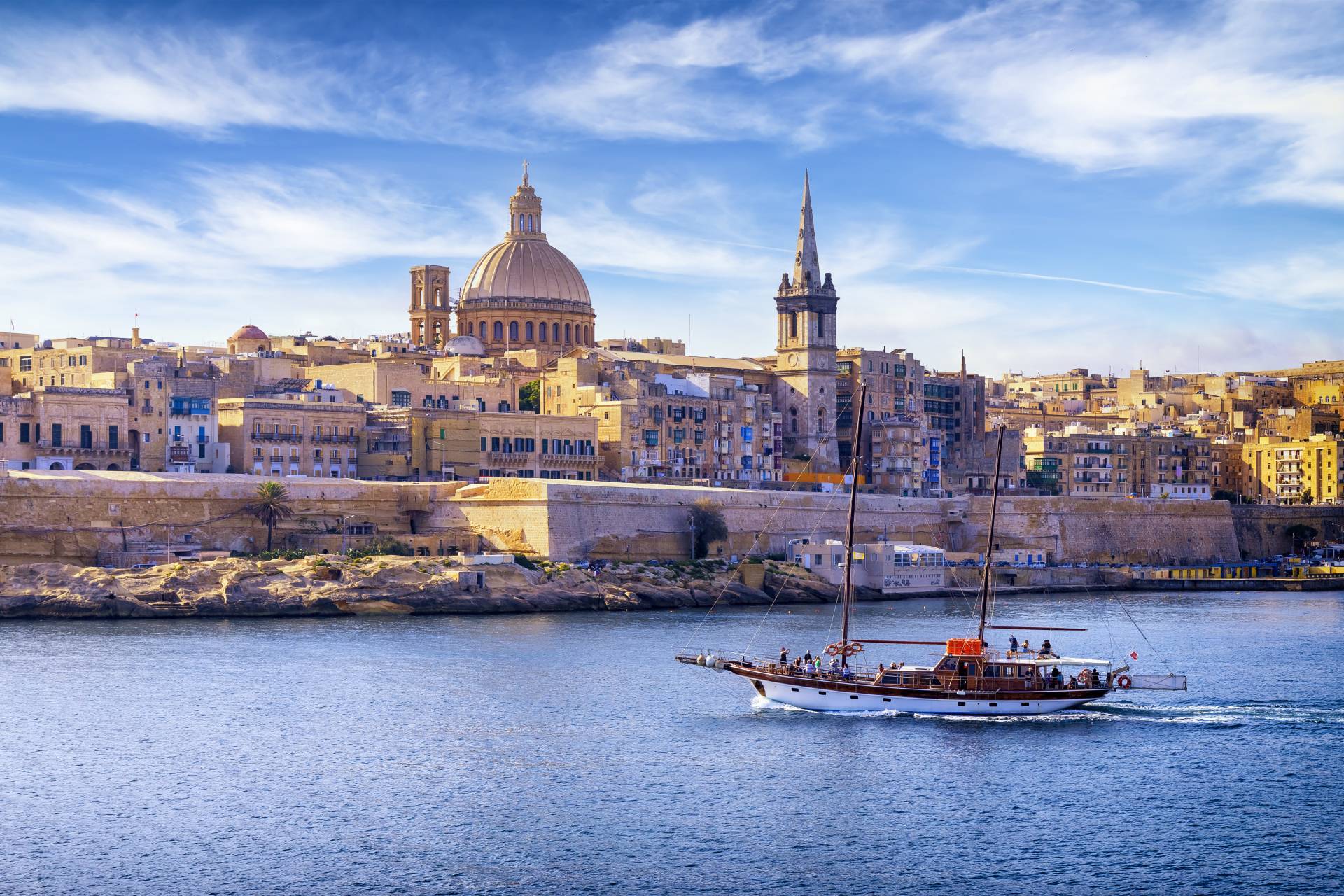
Valletta — the UNESCO-listed capital and one of Europe's smallest and most architecturally distinguished city centres — has emerged as a particular focus for high-net-worth buyers seeking character properties. Restored baroque townhouses and converted palazzos in the historic core now regularly achieve prices in excess of €1.5 million, with the finest examples commanding significantly more. Supply is structurally constrained: the city is compact by design, and the number of genuinely exceptional historic properties available at any given time remains very limited.
Sliema and St Julian's — the island's established cosmopolitan heartland — continue to attract buyers seeking modern high-specification apartments and penthouses with sea views. New-build luxury developments in these areas are typically priced between €5,000 and €9,000 per square metre for prime units, with trophy penthouses and duplex apartments in the best waterfront positions exceeding that range. The rental yield profile in these locations remains among the strongest in the Mediterranean, underpinned by a large professional and expatriate population and consistent tourism demand.
Further south, the Three Cities — Vittoriosa, Senglea, and Cospicua — offer an increasingly compelling proposition for buyers seeking authenticity and value relative to Valletta, with a growing number of sensitively restored historic properties attracting attention from discerning buyers willing to accept a quieter pace in exchange for architectural character and a genuine sense of place.
Gozo, Malta's quieter sister island, occupies a distinct niche. Traditionally the domain of lifestyle-led buyers — writers, artists, and those seeking genuine seclusion — it is now attracting a broader international audience drawn by its rural landscape, boutique farmhouse conversions, and a pace of life that is increasingly rare across the Mediterranean. Prices remain considerably lower than the Maltese mainland, representing genuine value in a European context.
Who Is Buying in Malta — and Why
The profile of international buyers active in Malta's luxury market has broadened considerably over the past decade. UK buyers remain a significant and consistent presence, drawn by cultural familiarity, the common law legal system, and English as the island's primary language of business and daily life — factors that make the transaction process more straightforward than in many continental European markets.
Middle Eastern buyers, particularly from the UAE and wider Gulf region, have become an increasingly important segment, motivated by Malta's EU membership, its Schengen access, and the island's position as a politically neutral and legally stable European base. For buyers from the region seeking a foothold within the European Union, Malta offers a rare combination of accessibility, governance quality, and lifestyle appeal.
Asian buyers — notably from mainland China, Hong Kong, and Singapore — have also been drawn to Malta, largely through the island's residency and citizenship-by-investment frameworks, which provide a clear and well-regulated pathway to European mobility. For internationally mobile families, the combination of an English-language education system, EU residency rights, and a Mediterranean lifestyle represents a genuinely distinctive package.
Across buyer profiles, the common thread is a search for jurisdictional security, capital preservation, and lifestyle quality — precisely the attributes that Malta, uniquely among smaller EU member states, is positioned to offer in combination.
Residency and Citizenship Programmes
Malta's residency and citizenship programmes remain a significant draw for international buyers. The Malta Permanent Residence Programme (MPRP) offers non-EU nationals the right to reside in Malta and travel freely across the Schengen Area in exchange for a qualifying property purchase or rental, alongside a government contribution. For buyers seeking both a lifestyle asset and a pathway to European residency, Malta offers one of the most accessible and well-regulated routes available — a factor that continues to drive demand from UK, Middle Eastern, and Asian buyers in particular.
The Malta Global Residence Programme (GRP) offers a complementary route for those seeking tax residency on the island. Qualifying residents benefit from a flat 15% tax rate on foreign-sourced income remitted to Malta, with a minimum annual tax payment. For internationally mobile high-net-worth individuals — particularly those reassessing their tax and residency position in the wake of changes to non-domiciled status in the UK — the GRP presents a highly competitive and well-structured alternative within the European Union.
It is worth noting that these programmes operate within a regulated framework and require professional legal and tax advice to navigate correctly. Polarius works with a network of trusted advisers in Malta who can guide buyers through the process alongside their property search.
Property Types in the Luxury Segment
Malta's luxury market offers a breadth of property types that few Mediterranean destinations can match. At one end of the spectrum, buyers will find newly completed high-specification penthouses and full-floor apartments in Sliema and St Julian's — buildings designed explicitly for the international market, with concierge services, private pools, underground parking, and uninterrupted sea views. These properties appeal to buyers seeking a lock-up-and-leave residence that requires no additional investment or renovation.
At the other end, the historic fabric of Valletta and the Three Cities contains some of the most architecturally significant residential properties in the Mediterranean — baroque palazzos with internal courtyards, grand staircases, and original decorative detail that simply cannot be replicated. These properties attract a different kind of buyer: one who values rarity, provenance, and the opportunity to be a custodian of something genuinely irreplaceable.
Between these two poles, there is a growing market for boutique villa developments on the Maltese coast and sensitively restored farmhouses on Gozo — properties that combine contemporary interior standards with traditional Maltese building materials and forms, and that appeal to buyers seeking privacy, outdoor living, and a more grounded connection to the island.
Outlook for Malta's Property Market
The fundamentals underpinning Malta's property market remain strongly positive as we move through 2026. The island's land supply is structurally limited and cannot expand — a constraint that provides a natural floor beneath prime property values over the long term. Tourism continues to grow, supporting the short-term rental market and sustaining demand for high-quality residential stock. The financial services and iGaming sectors, both of which have established significant operations in Malta, continue to generate a well-paid professional class that forms the backbone of domestic demand in the prime rental market.
At the upper end, international demand shows no sign of abating. If anything, the combination of ongoing geopolitical uncertainty in other parts of the world and the increasing attractiveness of Malta's residency and tax programmes is bringing new buyers to the market who might previously have looked elsewhere. For investors seeking a balance of security, lifestyle, and capital growth, Malta remains one of the Mediterranean's most compelling property markets — and one that, relative to comparable European destinations, continues to offer genuine value.
Click here for a selection of our current properties for sale in Malta.
Read our complete guide to buying property in Malta.